Have you ever wondered why some years feel like a non-stop victory lap while others feel like an uphill battle, even when your birth chart remains the same? In Vedic Numerology, the answer lies in timing.
While your birth grid provides the “Stable Energy” (Prarabdh) or the blueprint of your life, the Dashas (time periods) represent the “Moving Energy” (Kriyamaan). These cycles dictate when specific numbers in your grid “wake up” and start influencing your reality. Understanding these cycles allows you to move from being a passive observer of your life to a strategic navigator.
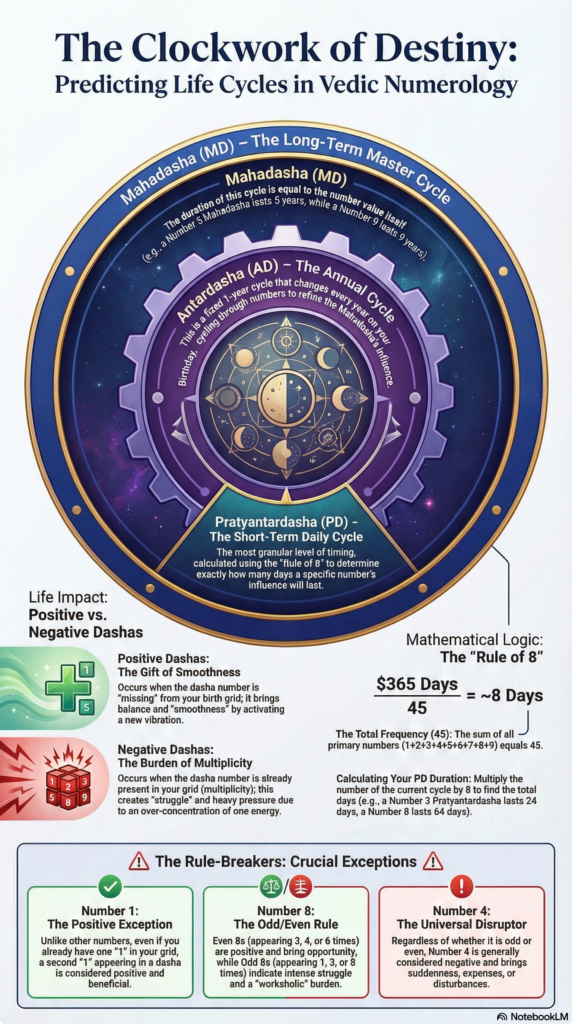
1. The Hierarchy of Time: Mahadasha, Antardasha, and Pratyantardasha
In the Vedic system, timing is broken down into three layers of influence. Think of it like a clock with an hour hand, a minute hand, and a second hand.
The Mahadasha (MD): Your Long-Term Theme
The Mahadasha is the overarching theme of a specific period in your life. The length of a Mahadasha is determined by the number itself. For example:
- A Number 1 Mahadasha lasts for 1 year.
- A Number 5 Mahadasha lasts for 5 years.
- A Number 9 Mahadasha lasts for 9 years.
During this time, the number of the Mahadasha is added to your grid. It either strengthens existing yogas (combinations) or creates new ones—some good, some challenging.
The Antardasha (AD): The Yearly Shift
Within every Mahadasha, there are sub-periods called Antardashas. Regardless of which number’s cycle you are in, an Antardasha always lasts for exactly 1 year, typically changing on your birthday. This is why your “personal year” can feel different from the general decade you are in.
The Pratyantardasha (PD): The Daily Pulse (The Rule of 8)
The most granular level of timing is the Pratyantardasha. This cycle tracks the tiny shifts that happen over days rather than years.
The Calculation: To find out how long a Pratyantardasha lasts, you multiply the number by 8.
- A Number 1 PD lasts 8 days.
- A Number 2 PD lasts 16 days.
- A Number 9 PD lasts 72 days.
2. Decoding the “Rule of 8”: Why 8?
You might ask, “Why 8? Why not multiply by 9, since there are 9 numbers in numerology?” The sources provide a fascinating mathematical explanation for this.
In Vedic Numerology, to complete a full sequence, you must pass through all numbers from 1 to 9. If you add these numbers together (1+2+3+4+5+6+7+8+9), the total is 45.
To find the daily multiplier, we take the number of days in a year (365) and divide it by this total (45).
365 / 45 = 8.11
For simplicity and ease of calculation, practitioners round this down to 8. This “Rule of 8” is the standard “thumb rule” used to track these micro-cycles.
3. Positive vs. Negative Dashas: The Missing Piece Logic
Not all Dashas are created equal. The impact of a number entering your life depends entirely on your original birth grid.
The Positive Dasha (The Smooth Phase)
A Dasha is considered positive when it brings a single missing number into your grid. If your birth date doesn’t have a 5, and you enter a Number 5 Dasha, that single 5 acts as a positive force, bringing stability and growth. These periods are characterized by smoothness and सौम्यता (gentleness).
The Negative Dasha (The Struggle Phase)
A Dasha is considered negative when it creates multiplicity—meaning the number is already in your grid and the Dasha adds more of it. For instance, if you already have a 2, and a Number 2 Dasha begins, the “double 2” can trigger emotional instability or depression. These periods often bring struggle and problems.
4. The Crucial Exceptions: When More is Better
Numerology is rarely black and white. There are specific instances where repeating numbers are actually a blessing:
- The Number 1 Exception: If you have one ‘1’ in your grid and a Number 1 Dasha creates a ‘double 1’, this is actually positive. It can boost your name, fame, and professional opportunities.
- The Number 8 Exception: While an “Odd 8” (a single 8) can make you a workaholic with high struggle, an “Even 8” (double 8s) is considered positive and brings significant opportunities.
- The Rahu/Destiny 4 Exception: Generally, Number 4 (Rahu) is seen as a creator of sudden problems. However, if a person with Destiny 4 enters a Number 4 Dasha, they often experience a massive surge in Money and Power, even if they face health or relationship hurdles simultaneously.
- The Venus/Destiny 6 Exception: Similarly, for a Destiny 6 individual, a Number 6 Dasha brings luxury and material comfort that might otherwise be diminished by multiplicity.
Calculate Your Vedic Birth Grid
Discover your Mahadasha, hidden voids, and planetary remedies in seconds.
5. What to Expect: A Number-by-Number Guide to Cycles
When you enter a Dasha, the “personality” of that number takes over your life. Here is a snapshot of what those cycles typically bring:
| Number | Positive Dasha Effects (Single Number) | Negative Dasha Effects (Multiple Numbers) |
|---|---|---|
| 1 (Sun) | Name, fame, promotions, and new professional beginnings. | Controversies, loss of reputation, and increased competition. |
| 2 (Moon) | Increased support from family/friends and deep emotional attachment. | Heartbreak, emotional events, and potential for depression. |
| 3 (Jupiter) | Expansion of business and growth in wisdom. | Family issues, disputes, or being forced to live away from home. |
| 4 (Rahu) | Interest in the occult (astrology/numerology) and travel. | Sudden losses, high expenditures, and documentation hurdles. |
| 5 (Mercury) | Financial stability and a desire for self-employment. | Financial instability, money mismanagement, and blunt communication. |
| 6 (Venus) | Increased luxury, brand consciousness, and romance. | Relationship conflicts and luxury items breaking or malfunctioning. |
| 7 (Ketu) | Increased luck and spiritual inclination. | Overthinking, life instability, and fear of losing family members. |
| 8 (Saturn) | (Even 8) Significant professional opportunities. | (Odd 8) Extreme struggle, delays, and property-related issues. |
| 9 (Mars) | Surge in courage and a desire for life changes. | High frustration, aggression, and being prone to accidents. |
6. How to Navigate a “Negative” Cycle
If you find yourself in a negative Dasha—perhaps a triple 2 causing anxiety or a multiple 5 causing financial leaks—don’t panic. The sources emphasize that these cycles are temporary “moving energies.”
While you cannot change the numbers of the time period, you can manage the energy field around you. The most recommended remedy for balancing “anti-energies” created by conflicting numbers is Energy Healing (such as Reiki, Yoga, or Meditation). These practices help balance your chakras and minimize the friction caused by the numbers.
Conclusion: Timing is Everything
Vedic Numerology teaches us that life isn’t just about what is in your grid, but when it arrives. By understanding your Mahadasha, Antardasha, and the daily “Rule of 8,” you can prepare for the storms and maximize the sunny days.
Remember: Even a “weak” or “negative” number like 4 or 8 can act as a spring, pushing you to great heights if you have the wisdom to handle the jump.